Already have a Grandstream? One setting.
No accounts to type in, no passwords, no port settings. Point the adapter at POTSBox once, and it sets itself up exactly like one of ours.
-
Open the adapter. On a Touch-Tone phone, pick
up and dial * * * (a voice menu starts), then
0 2—the voice reads you its address. Type
that into your browser. (Rotary phone? Find the
adapter in your router’s device list.) Log in as
admin; the password is on the sticker underneath. -
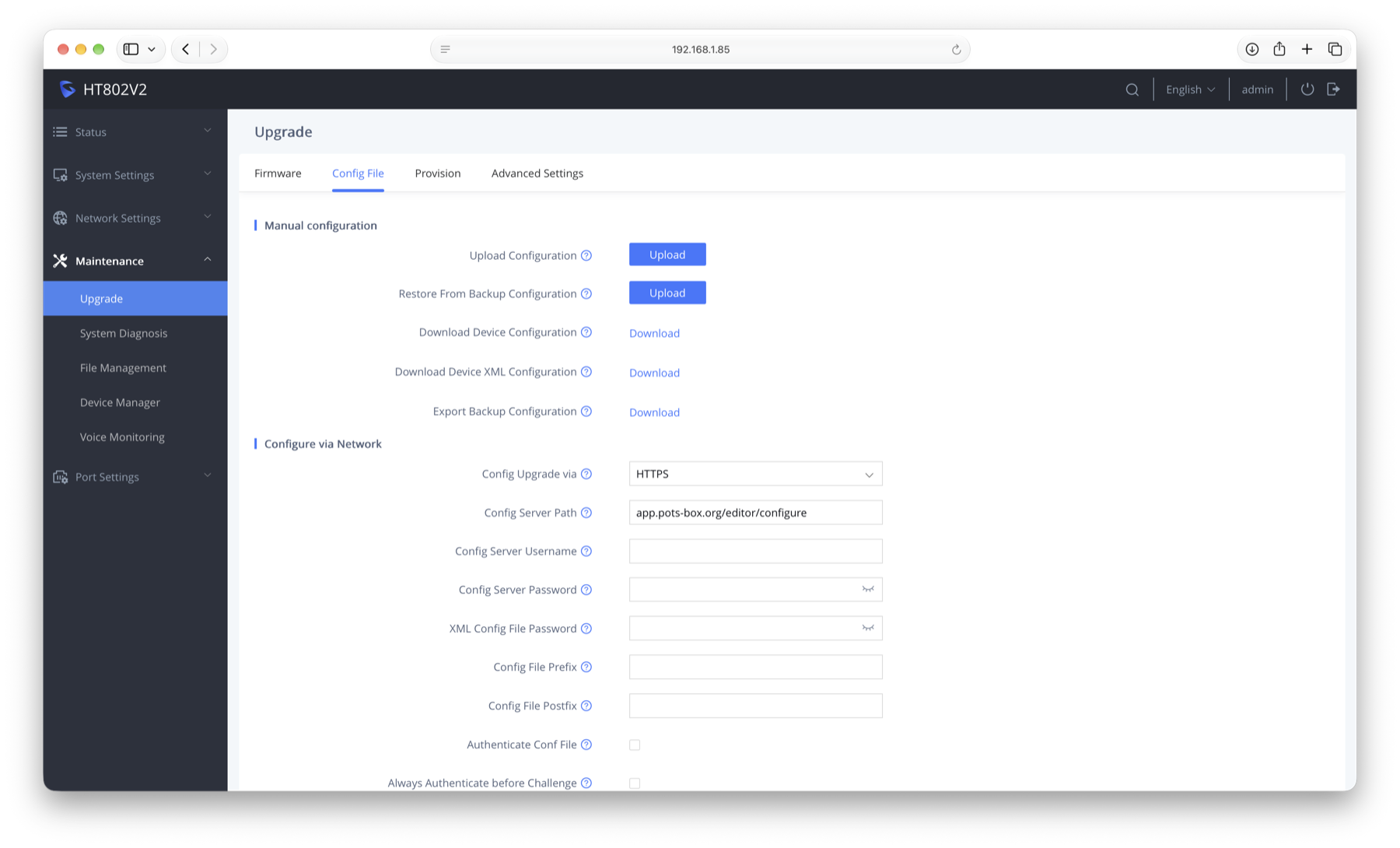
Go to Maintenance → Upgrade → Config File.
Under Configure via Network:
-
Config Upgrade via →
HTTPS -
Config Server Path →
app.pots-box.org/editor/configure
(exactly that—nohttps://in front)
-
Config Upgrade via →
- Save and Apply, then restart it with the power icon at the top right.
- Lift the handset. The Operator answers and asks for your email. If you hear a dial tone instead, dial 0.
Works with Grandstream HT801, HT802, HT812, HT814 and HT818 adapters.
Already using POTSBox on your own adapter?
Do this first, or your adapter will be treated as a brand new box and configure all the lines for you: pick up a phone, dial 0 and ask the Operator to change something — she learns the adapter from the call.
Then set the Config Server Path above. Your lines keep working exactly as they are; what you gain is the Operator being able to change that adapter for you by voice, and your line names showing as caller ID on the phone. Any socket we don’t know about is left untouched.